



Table of contents
Transparency note: Bean Products makes five of the eight mats below. We've included three mats we don't sell because leaving out the best options in categories we don't compete in wouldn't be useful to you. We earn nothing from the three outside links.
A yoga mat has to do three things: grip the floor, cushion your joints, and survive being rolled up and unrolled several hundred times a year. Most mats do two of the three. Long Yin and restorative holds go further with support under the knees and spine — what our best yoga bolsters are built for. And skip alcohol degreasers; shop natural yoga mat sprays and washes so rubber and PU coatings last.
This guide covers eight mats from under $30 to around $200, spanning natural rubber, PER, TPE, and cotton.
Our Top Picks at a Glance
|
Mat |
Best For |
Thickness |
Material |
Price |
|
Best overall |
1/4" |
Natural rubber + PU |
$89.95 |
|
|
Best thick mat |
6mm |
PER, SGS tested |
From $29.95 |
|
|
Best PVC-free |
6mm |
TPE |
From $34.95 |
|
|
Best value |
6mm |
[confirm material] |
$49.95 |
|
|
Best for restorative |
2" |
Cotton canvas + batting |
From $199.99 |
|
|
Best for hot yoga |
5mm |
PER + microfiber |
$64.95 |
|
|
Best travel mat |
1/8" |
Natural rubber |
From $79.95 |
|
|
Premium pick |
6mm |
Closed-cell PVC |
~$120 |
How We Picked These Mats
We're a manufacturer, not a review site, so here's exactly how this list was built.
We started from material composition and construction — what the mat is made of, how thick it is, how the surface is finished, and whether the manufacturer discloses any of it. Mats with vague or missing material information didn't make the list regardless of price.
From there we weighed grip characteristics against practice style, since a surface that works for slow Hatha is not the one you want in a heated room. We looked at how each mat is built to age: whether the foam compresses, whether edges fray, whether the surface can be cleaned repeatedly without degrading. And we considered price against expected lifespan rather than price alone, because a $30 mat replaced annually costs more than a $90 mat that lasts six years.
For our own mats, we know the construction because we specify it. For the three we don't make, we've relied on published manufacturer specifications and widely reported customer experience, and we've said so in each entry.
What we did not do is run a controlled lab test. Nobody's mat here has a numeric score attached to it, because we'd have to invent the scale.
Best Overall: Bean Rubber PU OMphibian Mat

The OMphibian pairs a polyurethane top surface with a natural rubber base. The PU layer is what makes it unusual: it grips better as it picks up moisture, so damp palms plant rather than slide. The rubber underneath gives it weight and keeps it from traveling across the floor mid-flow.
At 1/4" × 26" × 72" it's cushioned enough for kneeling work without floating you off the floor during balance poses. It's foldable rather than roll-only, wipes clean with a damp cloth and mild soap, and the rubber base holds its shape rather than compressing into permanent divots where your feet go.

Good: wet and dry grip, durable natural rubber base, foldable for transport, comfortable thickness for joints. Less good: costs more than basic mats, heavier than a travel mat, mild rubber smell at first, and like all natural rubber it needs to stay out of prolonged direct sun.
Best for: most people, most of the time — especially if you sweat and don't want to think about it.
Best Thick Mat: Yoga Monster Mat

Six millimeters of cushioning starting at $29.95. The Yoga Monster Mat is made from PER (polymer environmental resin) and is SGS tested to non-measurable phthalate levels. Phthalates are plasticizers that the EPA has assessed for health and environmental effects, and conventional mat foam can contain a lot of them, so getting them out at this price is the point of this mat.
At 72" × 24" the extra padding matters if your knees hit the floor regularly. It's thick without being so soft that standing poses feel unstable, it's washable, and it comes in more colors than anything else we make.

Good: the cheapest mat here, SGS certified phthalate-free, genuinely cushioned, washable, wide color range. Less good: grip fades when very wet, will compress under heavy daily use, standard width only.
Best for: anyone who wants joint padding and clean materials without spending much.
Best PVC-Free: SuperLite TPE Yoga Mat
If avoiding PVC entirely is the priority, this TPE mat is the one. Thermoplastic elastomer contains no PVC and no latex, and it's lighter than rubber at comparable thickness. Depending on your local facilities, TPE may be recyclable at end of life, which PVC generally isn't.
It's textured on both sides, cushions well for floor work, and carries a laser-etched alignment line and centering mandala — useful if you're working on symmetry without a teacher watching.
Good: no PVC, no latex, light to carry, alignment guides built into the surface. Less good: slick for the first few sessions until the surface breaks in, less durable than natural rubber.
Best for: practitioners avoiding PVC who still want thickness.
Best Value: Pro Eco GURU Premium Yoga Mat
The Pro Eco GURU is the straightforward one. It handles yoga, Pilates, stretching, and general floor work, cleans easily, and sits in the middle of our range at $49.95.
It isn't specialized. That's the point — if you practice a few times a week at home and don't need wet grip or extreme cushioning, paying more buys you features you won't use.
Good: versatile across disciplines, textured non-slip surface, easy to clean. Less good: not built for hot yoga, grip won't match a PU or rubber surface, one size.
Best for: anyone who wants a dependable everyday mat without overthinking it.
Best for Restorative: Natural Cotton Yoga & Pilates Mat
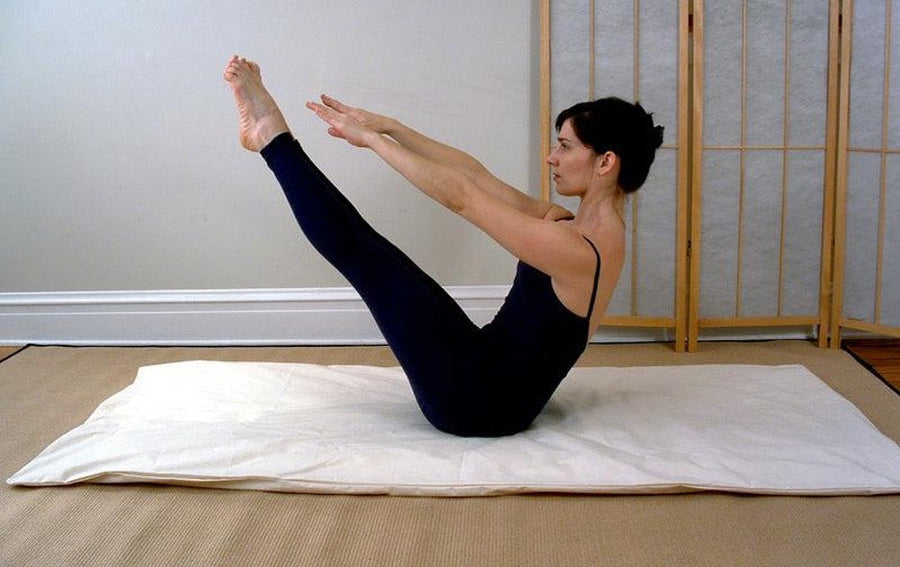
At two inches thick, the natural cotton mat isn't competing with the others — it's a different tool. Sturdy cotton canvas over pure cotton batting, 36" × 72", made in the USA. This is for Yin, restorative sessions, seated meditation, massage work, and floor-based Pilates where you're down for long stretches and want real padding under your hips and spine.
The 36" width is the other reason to consider it. Standard mats are 24", which means taller practitioners run out of mat in wide poses. Attached rollup ties and a shoulder strap handle the bulk.

It's the most expensive mat in this roundup, and it should be treated as furniture rather than a mat you throw in a bag. Washable covers are available separately, and there's a GOTS certified organic cotton version if that matters to you.

Good: substantial cushioning nothing else here matches, natural fiber, 36" wide, rollup ties and strap, organic option. Less good: far too soft for standing balance work, heavy, and the priciest option on this list.
Best for: restorative and meditation practice, or as a second mat alongside a thinner one.
Best for Hot Yoga: Aurorae Synergy 2-in-1
Not a Bean Products mat. The Synergy bonds a microfiber towel layer directly to a 5mm PER mat, so there's no separate towel sliding around underneath you. Aurorae states the surface grips more as it takes on moisture, which is the opposite behavior to a standard mat in a heated room. It's 72" × 24", machine washable, patent protected, and carries a two-year guarantee.
Worth knowing: there's no rubber or latex in it at all, which makes it an option if you react to rubber mats. Aurorae's own tip is to mist the top surface with water before you start if your hands are dry, since the grip depends on moisture.
Good: integrated towel replaces a separate purchase, grip designed to improve when wet, machine washable, latex-free. Less good: slow to dry, needs moisture to grip properly, we don't sell it.
Best for: hot yoga and Bikram, where a dry mat isn't a thing that exists.
Best Travel Mat: Jade Travel Mat
Not a Bean Products mat. The Jade Travel Mat is 1/8" open-cell natural rubber that folds rather than rolls, so it goes flat into a carry-on. At 3 lbs and 24" wide in 68" or 74" lengths, it grips remarkably well for something this thin. Jade makes it in the USA and plants a tree for every mat sold.
Two honest caveats. It starts at $79.95, so this is a premium travel mat rather than a cheap backup. And Jade notes its mats are 99% latex-free but may carry trace latex proteins, so they recommend anyone with a latex allergy avoid them.
Good: packs flat, real natural rubber grip despite the thin profile, no PVC, made in the USA. Less good: almost no cushioning, priced like a full mat, not suitable if you're latex-sensitive, UV damages natural rubber so don't leave it in the sun, we don't sell it.
Best for: frequent travelers who won't compromise on grip. Pair it with one of our yoga mat bags.
Premium Pick: Manduka PRO
Not a Bean Products mat. The Manduka PRO is dense, heavy, closed-cell PVC with a lifetime guarantee from the manufacturer. It doesn't compress, doesn't absorb sweat, and doesn't wear through. It's also around 7.5 lbs and needs a genuine break-in period before the surface grips properly.
Good: outlasts nearly everything, dense cushioning that stays dense, closed-cell surface stays hygienic, manufacturer lifetime guarantee. Less good: expensive, heavy, slippery until broken in, it's PVC, we don't sell it.
Best for: daily practitioners buying once and keeping it a decade.
Full Comparison
|
Mat |
Thickness |
Size |
Material |
Grip |
Price |
Made in USA |
|
1/4" (6mm) |
26" × 72" |
Natural rubber + PU |
Wet and dry |
$89.95 |
Yes |
|
|
6mm |
24" × 72" |
PER, SGS tested |
Slip-resistant, dry |
From $29.95 |
Yes |
|
|
6mm |
Standard |
TPE |
Textured, both sides |
From $34.95 |
No |
|
|
6mm |
Standard |
[confirm material] |
Stable, dry |
$49.95 |
No |
|
|
2" |
36" × 72" |
Cotton canvas + batting |
Textile surface |
From $199.99 |
Yes |
|
|
5mm |
24" × 72" |
PER + microfiber |
Wet grip (per maker) |
$64.95 |
Not stated |
|
|
1/8" (3mm) |
24" × 68"/74" |
Natural rubber |
Open-cell rubber |
From $79.95 |
Yes |
|
|
6mm |
26" × 71" |
Closed-cell PVC |
Dense, needs break-in |
~$120 |
Not stated |
Prices for mats we don't sell are current at time of writing.
Two things stand out across the table. Price tracks durability and size more than it tracks comfort — the $29.95 Yoga Monster cushions nearly as well as mats at three times the price, but won't last as long. And grip type matters more than most buyers expect, which is why the wet-grip mats cluster at the top for anyone practicing in a heated room.
How to Choose a Yoga Mat
Material. Natural rubber grips best, especially damp, and lasts longest, but it's heavy and carries trace latex. PER and TPE both weigh less and avoid latex entirely, at some cost in durability. Closed-cell PVC is the most durable surface but the least environmentally friendly. Cotton is for padding, not for grip. Research from the National Institute of Environmental Health Sciences on endocrine-disrupting chemicals in consumer products is a large part of why phthalate-free construction is worth paying attention to.
Thickness. Thin mats give you floor feel and stability. Thick mats protect joints. You can't have both at once, so pick based on what you do most.
|
Thickness |
Best for |
Floor feel |
|
1/8" (3mm) |
Balance work, standing poses, travel |
High |
|
1/4" (6mm) |
Joint support, general practice, restorative |
Moderate |
|
2" (cotton) |
Meditation, Yin, gentle stretching, Pilates |
Low |
Grip. For hot yoga or fast flow, you need a surface that performs wet — PU-coated rubber or an integrated towel layer. For slower practice, a textured dry surface is fine and usually cheaper.
Size. Standard is 72" × 24". If you're tall or you drift during flows, look at 26" or 36" widths.
Durability. A mat that needs replacing yearly costs more than a mat that doesn't. Washable surfaces, dense construction, and materials that don't crumble at the edges are what you're paying for at the top of the range.
Matching mat to style, briefly: hot yoga or Vinyasa wants 6mm with strong wet grip; Hatha or mixed home practice wants 1/8" to 1/4" phthalate-free; Yin or restorative wants 6mm or a cotton mat; kids' yoga wants small, light, and phthalate-free.
For certified natural options across our range, see our organic products, or browse all yoga mats and the wider yoga collection.
Frequently Asked Questions
What thickness is best? Thinner mats around 1/8" give stability and floor feel for balance work. Thicker 6mm mats cushion knees, hips, and spine for longer or restorative sessions. Cotton mats at around 2" are for seated and floor practice where you're not balancing.
How do I clean a yoga mat? Most wipe down with a damp cloth after practice. Some, including the Yoga Monster Mat and the Aurorae Synergy, are washable. Natural rubber mats generally aren't — Jade specifically says hand wash only and keep them out of direct sun, and the same applies to the rubber base on our OMphibian.
PER, TPE, or natural rubber? PER is durable, affordable, and grips well dry. TPE weighs less, avoids latex, and may be recyclable depending on your area. Natural rubber grips best, particularly wet, and lasts longest, but it's the heaviest of the three and isn't suitable if you're latex-sensitive.
How long should a mat last? Several years with reasonable care. We go into the specifics in how long do yoga mats last.
Can I use a yoga mat for meditation? Yes, and a thicker or cotton mat works better for it. Most people pair one with a bolster or cushion for a seated practice. Blocks help with alignment in floor work too.
How much should I spend? Around $30 gets a usable everyday mat. $80 to $120 gets one you won't replace for years. Above that you're buying specialty construction like the 2" cotton mat. The honest answer is that practice frequency decides it: twice a week, buy cheap; five times a week, buy once.
Bean Products has been making yoga and wellness goods in Chicago since 1987. More on that in our story, and on the fibers we work with in why hemp.


